
Key takeaways
- People search for categories (“bull bars adelaide”), not part numbers, so collection pages are a store’s main ranking pages. Give each one real copy.
- Rewrite titles and descriptions to say what you sell and where. Supplier text on hundreds of other stores gives Google no reason to pick yours.
- Check the technical basics once: collection paths to products, filter and tag pages, leftover app code, and redirects from any old site.
- If you have a shopfront, pickup or local delivery, your Google Business Profile and local pages can bring in searches the product pages never will.
On this page
Short answer: fix the collection pages first. Give each one a clear title, a heading and a few paragraphs in your own words that use the phrases people actually search. Then rewrite product titles and descriptions away from the supplier’s text, check a short list of technical settings, and make sure local customers can find your shopfront or pickup. If you want it done for you, that is our e-commerce SEO in Adelaide.
1. Collection pages are your ranking pages
People search for a category, then choose a product. Someone in Adelaide types “bull bars adelaide” or “camping fridge”, not a part number. Those searches belong to a collection page, and a stock Shopify collection is a grid of products with almost no words on it.
For each important collection:
- Title tag that says what it is and, where it fits, where you are: “Bull Bars Adelaide | Steel & Alloy Bull Bars” beats “Bull Bars | Store Name”.
- One heading that matches the main search, in plain words.
- A short intro above the products (two or three sentences) and more detail below: who it suits, what fits what, fitting or delivery in SA. Most themes show the collection description in one spot; we usually split it.
- Links between related collections (“bull bars” to “winches” to “recovery gear”), so customers and Google can move around the range.
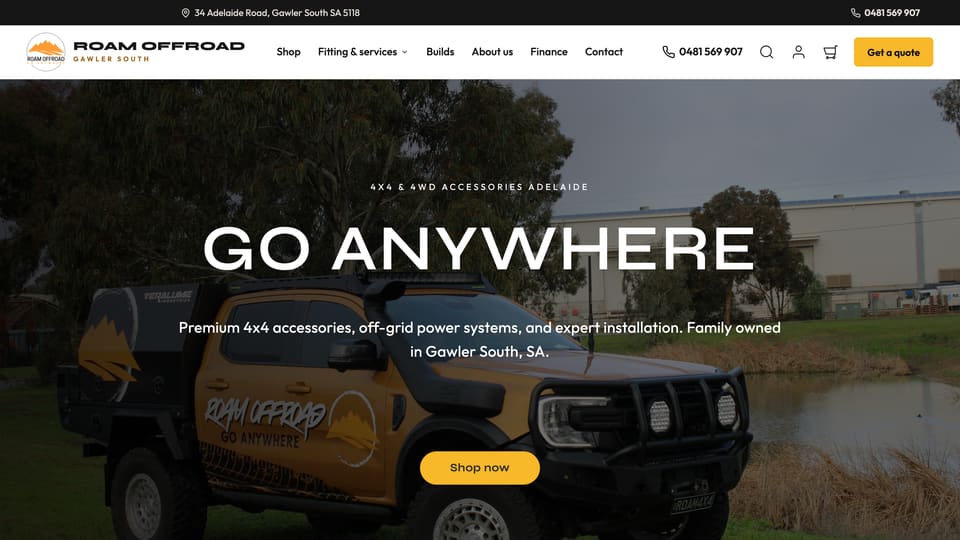
This was a big part of our work for Roam Offroad, a 4x4 accessories shop in Gawler with a big Shopify catalogue: we rebuilt the store from an existing base and rewrote titles and descriptions to say what the shop sells and where. “bull bars adelaide” averaged 17.0 in Search Console (11 Jul – 7 Aug) and 8.4 in 1 – 30 Oct 2026. Not everything has moved as far: “bullbars adelaide”, written as one word, came up from 33.7 (13 Jun – 10 Jul) to 14.9 in 1 – 30 Oct 2026, still page two.
2. Product pages in your own words
Hundreds of Australian stores paste the same manufacturer description. Google has little reason to rank the hundredth copy. You don’t have to rewrite every product, but do rewrite the ones that sell:
- Product title with the brand, model and what it is, the way a customer would type it.
- A paragraph in your own words on who it suits, what it fits and anything local (fitting, pickup, delivery times in SA). Keep the supplier’s spec table under it.
- Alt text on the main images that describes the product. Shopify has a field for it on every image.
- Variants, not duplicates. One product with colour and size options, not five near-identical products.
3. The technical settings worth checking once
Shopify handles more of this than most platforms, which is why the list is short.
- Collection paths to products. Many themes link to a product through a collection address like
/collections/bull-bars/products/…. Shopify adds a canonical tag pointing at the main/products/…address, which tells Google which one counts. Check your theme does this, and that menus and links use the main address where they can. - Tag and filter pages. Filters create lots of near-identical URLs. Shopify’s default settings keep some of them away from Google; don’t link to filtered views from your menus or blog.
- Leftover app code. Apps you no longer use can leave scripts in the theme that slow every page. Remove apps you don’t need, then check the theme for their leftovers.
- Images. Upload sensible sizes. Shopify serves resized versions, but a 6 MB banner still costs time on a phone.
- Search Console. Verify the store, submit
/sitemap.xml, and look at the Pages report once a month for products that aren’t indexed.
For anything deeper, such as theme speed or structured data, our technical SEO page covers what we check.
Free SEO audit
Want a person to check your Shopify store?
A person checks your website, your Google Business Profile and the searches you should be winning, then sends a PDF summary with the fixes in priority order within 1–2 business days.
4. Local customers: shopfront, pickup and delivery
Plenty of SA stores aren’t online-only. If you have a shopfront, a warehouse pickup or local delivery, you can win searches that product pages never will.
- Google Business Profile with the right categories, products and the area you serve. For Roam that meant categories, services and products built out for Gawler and northern Adelaide; “4x4 accessories” was #1 on Google Maps from Gawler in a live check on 5 October 2026.
- A delivery and pickup page that names where you deliver in SA, how long it takes and what it costs. Customers read it before they buy.
- Shipping and returns details set up properly in Shopify, so Google’s shopping features can read them.
5. Moving to Shopify from Wix or WordPress
A platform move is where stores most often lose rankings, nearly always because old product and collection addresses weren’t redirected. Shopify’s fixed prefixes mean almost every URL changes, so every old address needs a redirect to its closest new page, and retired products should go to their collection, not the home page. My Positive Perspectives moved from Wix to Shopify this way, with every product and URL carried across. The website migration checklist walks through it step by step.
The order, on one page
- Collection pages: titles, headings and real copy for the top ten collections.
- Product titles and descriptions for your best sellers.
- Technical check: canonicals, filters, app leftovers, Search Console.
- Google Business Profile and a delivery and pickup page, if you serve locals.
- Then new content: buying guides that link to the collections they’re about.
Want a second opinion on your store? Send the store address with the free SEO audit request. We check your collection pages, technical setup and the searches you should be winning. Ongoing work for stores is our e-commerce SEO service.
Frequently asked questions
Is Shopify good for SEO?
Yes, for most stores. It handles the sitemap, secure pages and mobile layout for you, and lets you edit titles, descriptions, URLs and image alt text. Its limits are fixed URL prefixes like /products/ and /collections/ and less control over some code than a custom build. Those rarely hold a South Australian store back. Thin collection pages and copied product text do.
Do I need an SEO app for Shopify?
Usually not. Titles, descriptions, alt text, redirects and the sitemap are all built in. Some apps help with bulk edits or structured data, but every app adds code, and apps you uninstall can leave scripts behind. Add one only for a job the built-in settings can’t do.
Should collection pages or product pages rank?
Mostly collection pages. Searches like “bull bars adelaide” or “roof top tent” ask for a range to choose from, which is what a collection is. Product pages rank for model names and part numbers. Write the collection pages first.
How do I move from Wix or WordPress to Shopify without losing rankings?
Export every old URL, map each one to its new Shopify address, and add them all to Shopify’s URL redirects before launch. Keep the copy that was ranking. Our website migration checklist has the full list.
Evidence used in this article
- Shopify Help Center: every store gets an automatically generated sitemap.xml; page titles, meta descriptions and URL handles can be edited for each product, collection, page and blog post; old URLs can be sent to new ones with URL redirects.
- Shopify’s URL structure: products live under /products/, collections under /collections/, pages under /pages/ and blog posts under /blogs/. These prefixes can’t be removed.
- Google Search Central, “Consolidate duplicate URLs”: use a canonical link to tell Google which of several similar URLs is the main one.
- Roam Offroad (Gawler, Shopify): Search Console averages and live Google checks as published in its case study.
Free SEO audit
Want this checked on your own site?
Tell us your website and the searches that matter. You’ll get honest advice and a clear recommendation within 1–2 business days, with a PDF summary of fixes in priority order.
Get my free audit →